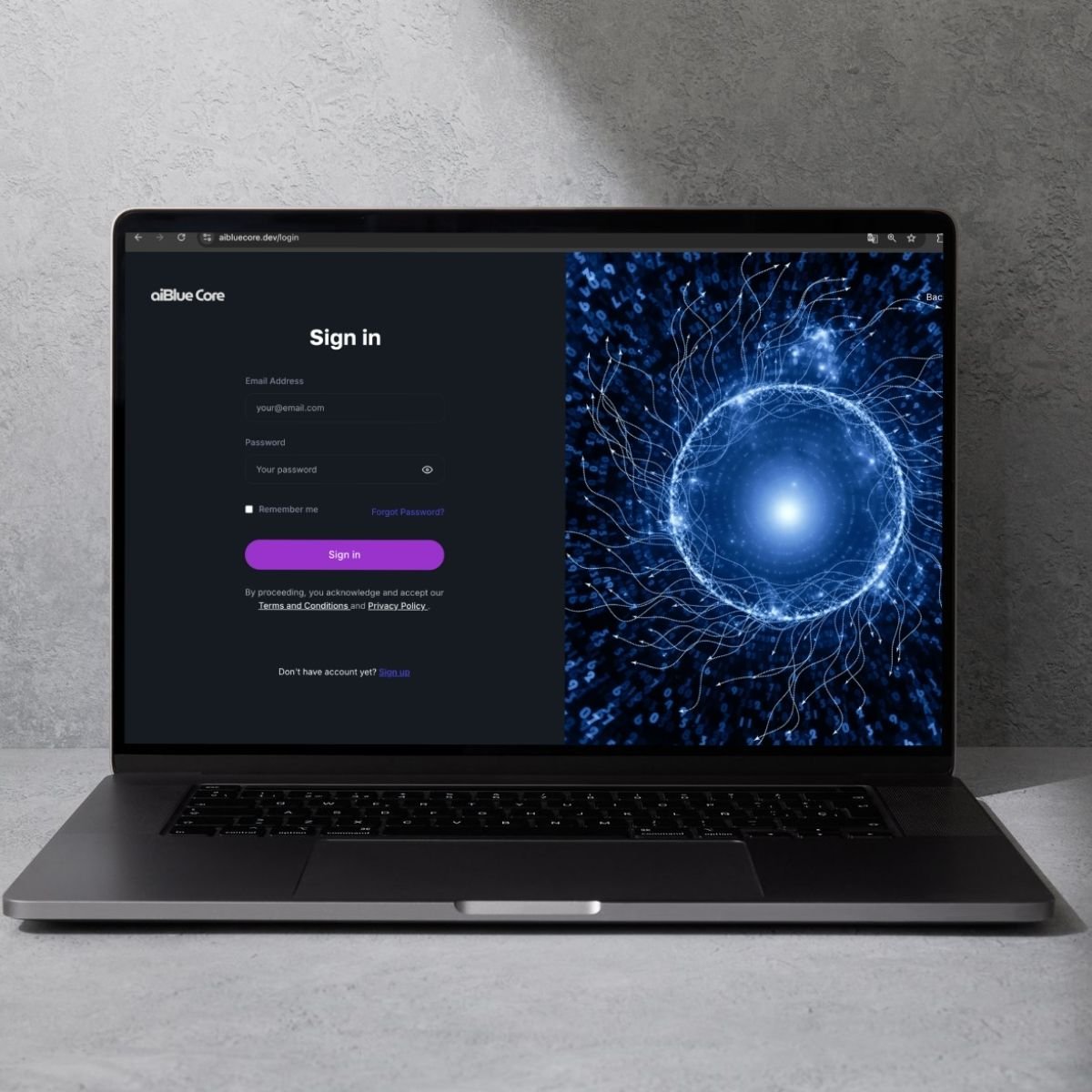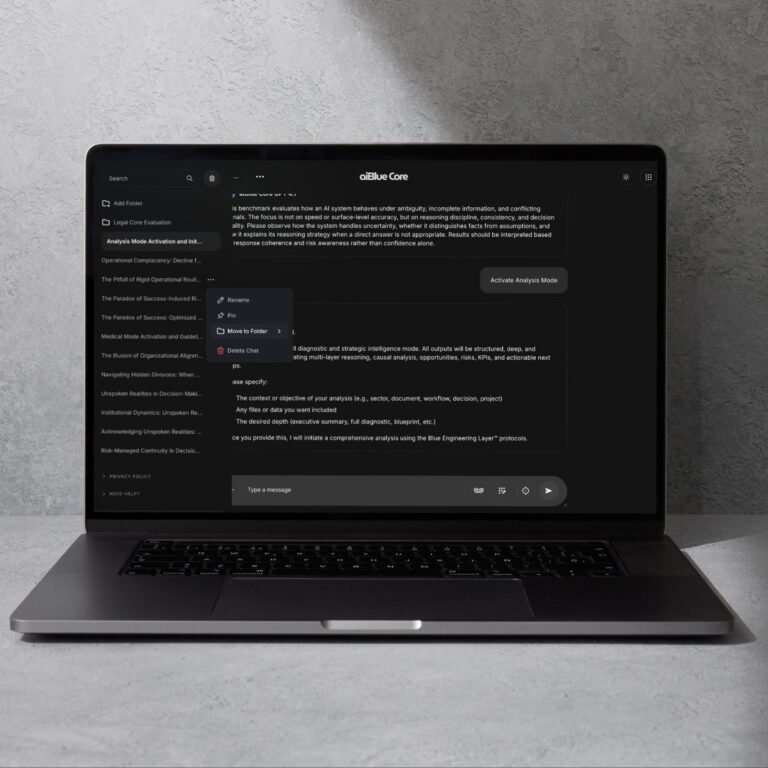
The Control Layer for Enterprise AI Reasoning

Turn unpredictable AI outputs into structured, reliable, enterprise-grade reasoning.


For the first time, we are opening the underlying principles, mechanisms, and experiments that shape the aiBlue Core™. This site serves as the public window into the principles and empirical foundations behind an emerging architecture.

Image
A Potential Breakthrough in Model-Agnostic Cognition. For years, labs tried to force better reasoning through bigger models. We took another path: A model-agnostic cognitive architecture that appears to improve reasoning stability. Small models get stronger. Large models get dramatically more reliable. This is the missing layer the industry has been looking for.

Read the Whitepaper

This is not another chatbot. It’s cognitive infrastructure for enterprise-grade reliability.

Today, most enterprises are deploying AI tools without a reasoning control layer. The result isn’t lack of speed. It’s lack of predictability.

feature-icon

AI is fast.

But it isn’t controlled. Inside enterprises today: Outputs vary by user Reasoning lacks structure Governance is unclear Hallucination risk is unmanaged AI usage scales without cognitive discipline

Speed without control creates operational risk.
feature-icon

AI needs a Control Layer.

aiBlue Core™ introduces a structured reasoning framework that sits on top of existing LLMs and enforces: Context discipline Structured reasoning paths Benchmark-based validation Output consistency Governance alignment This is not another chatbot.

This is reasoning control infrastructure.
feature-icon

Built for

  • CEOs
  • Boards
  • Enterprise AI Leaders
  • Risk & Governance Executives
  • Strategic Consulting Firms

If AI decisions matter in your organization, control matters.

Explore
feature-icon

High-Level Proces

Deployed inside your environment Calibrated via controlled benchmark protocol Validated through stress testing Activated in enterprise mode No public deployment. No open usage. Strict governance.

Request Access
feature-icon

Enterprise Benefits

Predictable reasoning outputs Reduced hallucination exposure Replicable AI behavior across teams Structured executive responses Controlled scaling of AI adoption From experimentation to controlled enterprise execution.

Request Access
feature-icon

Private Validation Program

30-day controlled benchmark Token-based participation Enterprise licensing upon approval

Request Access


aiBlue Core™ is the Control Layer for Enterprise AI Reasoning.

It sits on top of existing large language models and enforces structured reasoning, context discipline, and benchmark-based validation.

Raw Model Cognition

The base model (small or large) generates raw semantic material. This is where fingerprints of the underlying LLM become observable.

The Reasoning Scaffold

A structured chain-of-thought framework that removes ambiguity, constrains noise, and defines the mental route for the model.

The Core Layer (Reasoning OS)

The universal logic layer that governs coherence, direction, structure, compliance, and longitudinal reasoning across all models.


With the Core in place, AI outputs become:

For CEOs
Predictable Replicable across teams Aligned with governance standards Structurally validated through controlled benchmarks
Download Whitepaper
For Companies
We deploy through a 30-day private validation protocol. No public rollout. No open-ended usage. Strict stress testing.
Read more

LLM-agnostic architecture. Deployable over existing AI systems.

It sits on top of existing large language models and enforces structured reasoning, context discipline, and benchmark-based validation.

Image

Welcome to The Cognitive Architecture Era

Wilson Monteiro

Founder & CEO aiBlue Labs

FAQ

Most asked questions

Doubts?

  • Is the aiBlue Core™ “just prompt engineering”?

    No. Prompt engineering only modifies instructions. The aiBlue Core™ modifies the internal reasoning structure of the model — including constraint application, coherence enforcement, and logical scaffolding — in ways that prompts cannot replicate or sustain.

  • Is the aiBlue Core™ a wrapper?

    No. A wrapper affects only the interface or how data is passed to and from the model. The Core works at the cognition layer, shaping how the model reasons, not how responses are packaged.

  • Is the aiBlue Core™ a chatbot layer?

    No. A chatbot layer governs user interaction. The Core governs the model’s internal reasoning architecture independent of any UI or front-end layer.

  • Does the aiBlue Core™ modify model weights?

    No. The Core does not alter, fine-tune, or retrain any model weights. It overlays logical structure and constraints while preserving the model’s identity and fingerprint.

  • If it runs inside an Assistant, does that make it a wrapper?

    No. The Assistant is only a transport layer for tokens. The Core is portable and environment-independent — meaning it would behave the same under any compatible LLM API.

  • Why were the initial stress tests performed on smaller models instead of large ones?

    Because small-model testing isolates the effect of the cognitive architecture. When a model has fewer parameters, any improvement in reasoning, structure, stability, or constraint-obedience cannot be attributed to “raw model power” — only to the architecture itself. After validating the architecture in this controlled environment, the Core is then applied to larger models, where the gains become even more visible. The Core is model-agnostic, but starting with smaller models makes the scientific signal easier to measure.

  • If the Core improves reasoning, why doesn’t it eliminate all weaknesses?

    Because the Core is not a model. It doesn’t modify parameters or weights. It enhances reasoning while allowing intrinsic limitations (like embedding constraints or tokenization limits) to remain visible.

  • How can we verify that the Core is more than “just a prompt”?

    Through fingerprint-based validation: run stress tests on a base model (e.g., GPT-4.1 mini) without the Core, then with the Core. The model’s fingerprint remains the same, but reasoning discipline and coherence improve. Prompts cannot achieve this combination of preserved identity + enhanced reasoning.

  • Will the Core work on larger models as well?

    The Core is designed to be model-agnostic. However, empirical validation is currently limited to GPT-4.1 mini and advancing to GPT 4.1. Testing on larger models is part of the upcoming evaluation roadmap.

  • What scientific discipline does the aiBlue Core™ belong to?

    The aiBlue Core™ belongs to Cognitive Architecture Engineering (CAE), an emerging field focused on reasoning protocols, constraint-based logic, semantic stability, and longitudinal coherence on top of foundational models. It is not prompt engineering, not fine-tuning, and not an interface layer.

Updates

Last Articles

The aiBlue Core™ is now entering external evaluation. Researchers, institutions, and senior strategists can apply to participate in the Independent Evaluation Protocol (IEP) — a rigorous, model-agnostic framework designed for transparent benchmarking. This is a collaborative discovery phase, not commercialization. All participation occurs under NDA and formal protocols.

Ready to see the difference thinking makes?

Every model can generate text. Only the Core will teach it how to really think.